 News
NewsCommitted investment in Oman’s Duqm zone reached OMR8.818 billion
Investment commitments reported at end-June were 141 percent higher than in 2021. Oman also outlined port cargo, refinery capacity and dry-dock activity.
Event / data period: 2026-09-23
Published: · Updated:
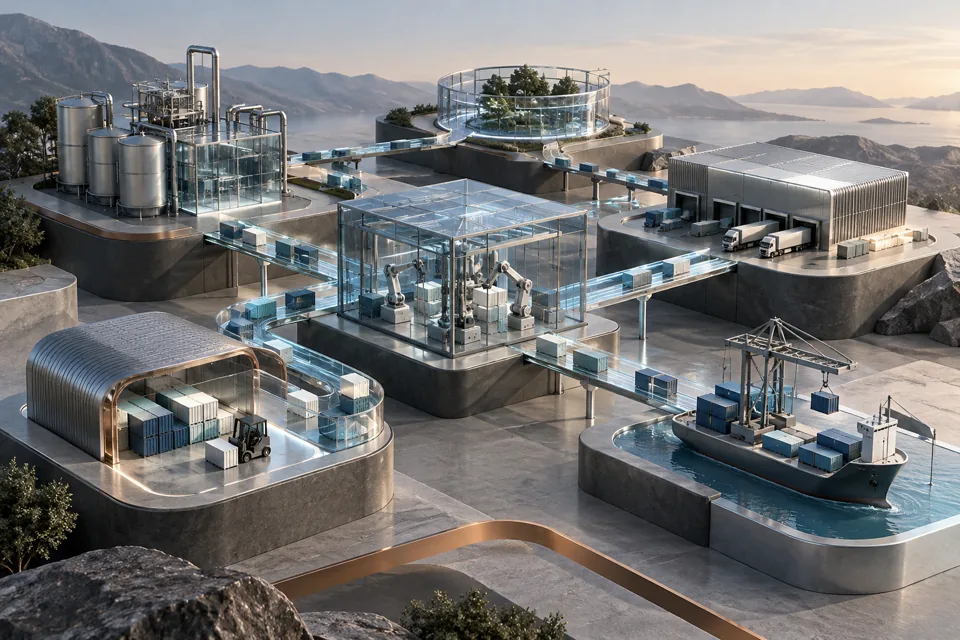 Illustration
During Sultan Haitham bin Tarik’s visit to the Special Economic Zone at Duqm on 23 September 2026, officials said cumulative committed investment in the zone had reached OMR8.818 billion by the end of June. The Oman Foreign Ministry’s account of the briefing compares that figure with OMR3.65 billion in 2021, an increase of 141 percent. It is described as committed investment, not paid-in capital, the completed cost of projects or the total value of finished assets.
The chairman of the Public Authority for Special Economic Zones and Free Zones linked the increase to improvements in the investment environment and infrastructure over the previous five years. Investment-promotion work and incentives and facilities for investors were also cited. Those are the official’s explanations; the published total does not show separately how much of each commitment has been contracted, financed or spent. A project list and periodic execution data would be needed to determine the share of commitments that has become operating investment.
Port of Duqm indicators in the briefing cover 2021 to 2025. Total cargo handling increased by 5.66 percent, dry-bulk handling by 3.88 percent, and roll-on/roll-off cargo by 8.2 percent. The statement also describes growth in containers, oil and gas field pipelines, and goods required by projects in the zone. It does not provide tonnage or base values for those subcategories, so the percentages do not reveal which cargo type contributed most to the overall change.
The Duqm Refinery’s capacity was reported to have increased to 255,000 barrels per day. The dry dock completed approximately 1,340 projects from 2020 through the end of 2025, officials said. These figures indicate activity beyond port cargo flows, including industrial and maritime services. Refining capacity is not the same as actual production, however, and a count of “projects” does not by itself state the number of vessels repaired or the total value of work performed.
Officials describe Duqm’s development as an economic zone and logistics hub built around its strategic location and infrastructure investment. Its longer-term growth may depend on connections among the port, refinery, dry dock and local suppliers; that is an economic interpretation of the activities listed in the briefing. Investment commitments and cargo handling are different measures: one tracks stated capital intentions for projects, while the other tracks cargo movement through the port.
Plans outlined for the future include attracting projects in tourism, commerce and logistics, and creating conditions for education and healthcare services that could support a resident workforce. Alignment with Oman’s net-zero objective and development of green hydrogen were also identified as areas of work. The announcement did not give new investment values, final project schedules or operating dates for those areas. Planned sectors should therefore not be described as if facilities are already operating.
Useful milestones to follow include which sectors and projects receive the investment commitments, whether they reach financing and construction stages, annual port volumes by cargo type, and refinery capacity utilization. For the dry dock, the mix of project types and utilization would add context to the headline count. The OMR8.818 billion figure shows the scale of Duqm’s investment pipeline, but measuring economic outcomes will require commitments, spending, production and employment to be reported separately.
The visit announcement can therefore be read as a current indicator of Oman’s effort to position Duqm as a regional centre connecting port, industrial and logistics activity. The figures cover growth in committed capital over five years and the 2021–2025 movement in selected cargo categories; they do not show that all announced investments have been completed. Preserving that distinction is important so that a report on project commitments is not mistaken for a conclusive measure of investment success.