News
NewsEWEC forecasts a reduction of more than 45% in Abu Dhabi power and water emissions by 2035
The utility’s long-term plan projects lower emissions despite rising electricity demand; its solar, battery and reverse-osmosis targets are not completed outcomes.
Event / data period: 2026-09-21
Published: · Updated:
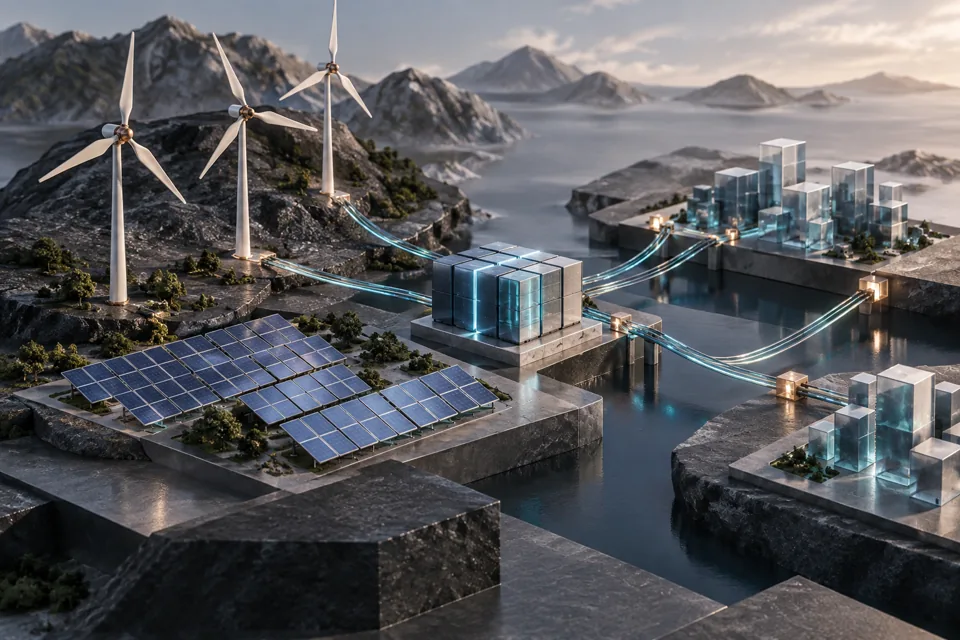
 Illustration
Emirates Water and Electricity Company (EWEC) expects total carbon emissions from power and water production in Abu Dhabi to fall to about 23 million tonnes in 2035. A long-term system outlook reported by the Emirates News Agency (WAM) on 21 September 2026 projects a reduction of more than 45% from approximately 42 million tonnes in 2019. These figures are planning projections, not an observed 2035 result. The stated emissions boundary covers power and water production; it does not cover every sector of the economy or all emissions in the country.
The same outlook forecasts annual electricity demand to rise by around 70% between 2026 and 2033. EWEC’s scenario therefore does not assume a shrinking energy system: it projects that more electricity and water supply can be delivered while emissions from production decline. Assessing that outcome requires supply volumes, plant utilisation, the fuel mix and the calculation method. WAM’s report gives no modelling assumptions, annual interim milestones or breakdown of which customer groups are expected to drive demand growth.
The plan centres on increasing solar capacity to 14 gigawatts by 2030 and more than 35 gigawatts by 2035. EWEC also expects up to 15 gigawatts of battery storage capacity to support that expansion. These are planned capacity goals and an upper limit, not a claim that all projects are built or operating. Battery capacity reported in gigawatts measures power, not the duration of storage or the total energy in gigawatt-hours.
Because solar output varies with sunlight and weather, flexible generation and storage also matter to system operation. EWEC says the contribution from gas-fired generation is expected to decline as new capacity is commissioned; it does not announce that gas plants will immediately close or disappear. The company also notes that gas generation provides flexibility to balance variable renewable output. The plan thus addresses supply reliability and the need to serve demand continuously alongside its emissions objective.
On the water side, EWEC forecasts that reverse-osmosis desalination will account for more than 95% of total water production by 2035. It identifies expansion of the reverse-osmosis portfolio as one of the main drivers of lower emissions. The announcement does not quantify current and future water volumes, energy consumption per plant, seawater withdrawals or brine management. The market-share target alone therefore does not show how many current facilities will change or how water costs may move.
Having emissions fall while electricity and water demand rise makes capacity planning and the speed of connecting lower-carbon resources central to the forecast. Delivery depends on solar and storage projects being completed on schedule, grid connections, operating efficiency and the reverse-osmosis share of water production. WAM’s report gives no investment budget, consumer tariff outlook, contract costs or commissioning date for each facility. The emissions projection is not evidence that project costs or household utility bills will fall.
For readers, a key distinction is between total emissions and emissions intensity. EWEC’s more-than-45% reduction compares total carbon from power and water production in 2019 and 2035; it does not provide emissions per megawatt-hour or per unit of water. Those intensity measures could show more directly how the system becomes cleaner as supply expands. Future progress reports with commissioned capacity, output, fuel mix, annual emissions and forecast variance would make the route to the 2035 projection possible to assess.
Data
EWEC 2035 power and water outlook
Approximate total emissions figures and a demand-growth forecast reported in EWEC’s planning outlook.
- Carbon emissions from power and water production (approximate baseline)
- 42 million tonnes
- 2019 · Estimate
- Carbon emissions from power and water production (2035 forecast, approximate)
- 23 million tonnes
- 2035 · Forecast
- Total growth in annual electricity demand between 2026 and 2033 (forecast)
- 70 percent
- 2026 — 2033 · Forecast
Methodology
The source uses approximate figures and forecast language. The 2019 value is an approximate historical baseline, the 2035 value is projected, and demand growth covers the 2026–2033 forecast period. These figures are not presented as realised outcomes or independent measurements.
Updated: